


LSU Researcher Hunts Lithium in Louisiana Oilfield Brines
March 19, 2026
The United States imports 25% of its lithium, which is listed as critical mineral by both the U.S. Department of Energy and the U.S. Geological Survey. Meanwhile, brines in the Smackover Formation, which stretches from Texas to Florida through Louisiana, could help meet domestic and global needs.
Pinpointing the richest brines requires extensive and time-consuming sampling and analysis. LSU researchers hope to make the search for lithium-rich brines faster by characterizing the formation waters, defining what's in them and how it came to be there.
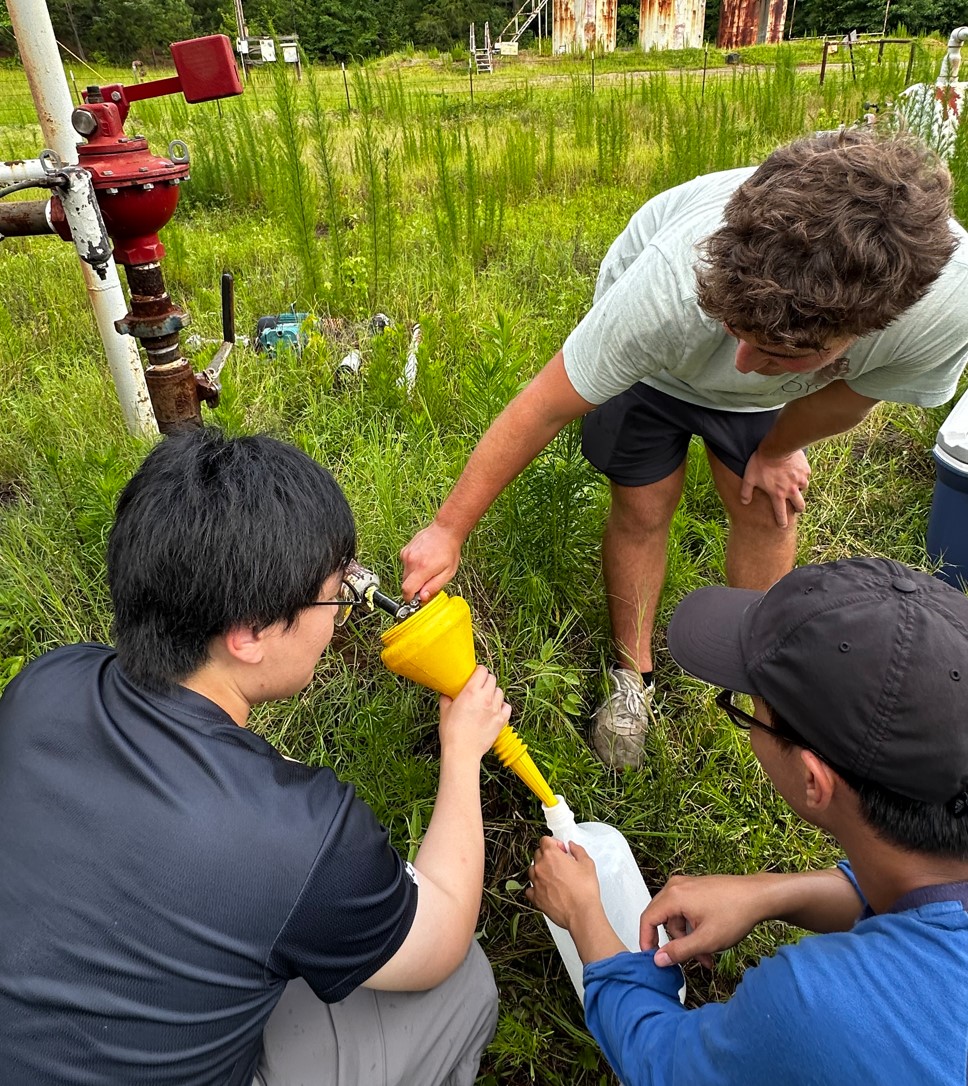
Petroleum Engineering Graduate Assistant Ruoqin Pei and students Walter Scheuermann and Tan Ngueyn pull brine samples from a well in the Smackover Formation.
“Once we understand how the brines may have originated, that's when we'd be able to predict where else they might occur," Department of Petroleum Engineering Associate Professor Ipsita Gupta said.
Developing a multibillion-dollar lithium project can take a decade or more. The global lithium supply will fall short by an estimated 40 percent in 2040. Time is of the essence.
Characterizing the formation waters is part of Gupta's effort to determine whether the Louisiana section of the Smackover contains commercial levels of lithium, for today or the near future.
That project received $261,000 from Idaho National Laboratory/Batelle Energy Alliance through the U.S. Department of Energy.

Department of Petroleum Engineering Associate Professor Ipsita Gupta
The Smackover is a Jurassic Age formation, approximately 150 million years old. The brines likely have a complex history that includes remnants of ancient sea water and other fluids that interacted with the surrounding minerals and chemicals over millions of years.
Lithium concentrations of upwards of 200 parts per million (ppm) are needed to make extraction profitable with current methods. In late 2024, the U.S. Geological Survey found lithium concentrations of 400 ppm in brines in the southwest Arkansas portion of the formation.
That report sparked a lithium rush in Arkansas and Texas, along with concerns about threats to public and environmental health from the water-intensive process and the possibility of toxins polluting freshwater resources. ExxonMobil, Chevron, and General Motors are among the companies that have announced plans to extract lithium on thousands of acres in the Smackover.
Gupta said it’s too early to say whether the Louisiana portion of the Smackover will yield similar lithium amounts. However, even brines with lower concentrations, 70-80 ppm, could prove commercially viable in the next few years as research advances.
“Technology always improves,” Gupta said. “When we were students, shale was only an oil source rock. It was never considered a producer. But then hydraulic fracturing changed everything.”
Twenty years ago, no oil came from domestic shale formations. Today, shales account for more than 60% of U.S. production.
Gupta’s project involves researchers in California (Berkeley Lab) and Idaho (Idaho National Lab), a development she describes as “scientifically exciting and very collaborative.” Her team is analyzing brine samples from 14 different wells in Louisiana for 21 elements in addition to lithium. Those elements include the critical minerals boron, cobalt, chromium, copper, lead, magnesium, manganese, nickel, rubidium, vanadium and zinc.
LSU’s wet lab facilities in the Department of Oceanography and Coastal Sciences perform the analysis. The samples can only be analyzed for a few elements at a time, so it takes weeks to months to complete the evaluation for each well.
After completing the Louisiana project, Gupta and her team plan to apply for funding to research critical minerals’ presence in the rest of the Smackover.
“We should study the entire formation and sample much more than we are sampling right now,” she said. “Because there’s a lot of variability in the concentrations of lithium.”
By mapping the entire formation, Gupta’s research could establish baseline data for future critical minerals extraction, providing a guide for producers as technology advances and prices change.