
Research Facilities & Resources
The LSU Department of Physics & Astronomy advances research through collaborations
with a wide range of centers, institutes, and specialized facilities. Some resources
are housed within the department, while others are available through university partnerships
and external affiliations. Together, they provide faculty and students with advanced
equipment, computing resources, technical expertise, and opportunities for interdisciplinary
research. The department is also home to the Louisiana Space Grant Consortium (LaSPACE),
which supports aerospace research, education, and workforce development throughout
Louisiana.
CCT
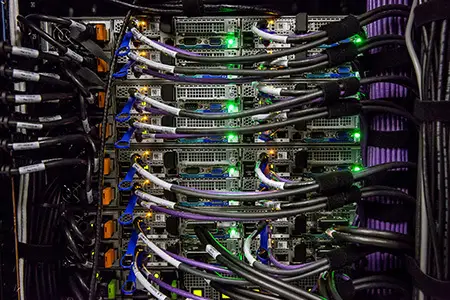
The Center for Computation & Technology (CCT) is an interdisciplinary research center located on the campus of Louisiana State University in Baton Rouge, Louisiana, that promotes economic development for the state by using computational applications to aid research and develop solutions that benefit academia and industry. LSU's CCT, in a joint partnership with LSU's Information Technology Services, provides access through HPC@LSU to some of the best university-based supercomputers as well as system administration and consultation support for the Louisiana Optical Network Infrastructure (LONI) supercomputers.

HASP
The High-Altitude Student Platform (HASP) program offers up to 24 payload seats for student-developed experiments on a small-volume, zero-pressure balloon flight reaching altitudes of approximately 120,000 feet (approximately 36 km) for around 10 hours. Seats on HASP are competitively awarded to student teams at colleges and universities in the United States and abroad. HASP is supported by the Astrophysics Division of the NASA Science Mission Directorate, the NASA Balloon Program Office, Wallops Flight Facility, and the Louisiana Space Grant Consortium, administered through the Department of Physics & Astronomy at Louisiana State University.
HRPO
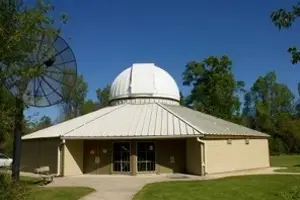
HRPO-Highland Road Park Observatory is located in BREC's Highland Road Park. The 20-inch reflecting telescope is located inside the retractable dome.
LSU's Department of Physics and Astronomy secured funding for the 20-inch and 16-inch telescopes and the equipment needed to operate them. The Department's faculty and graduate students are consistently involved in HRPO's public programs by volunteering as guest speakers and telescope operators, and by sharing their expertise in astronomy.
LA Space Grant
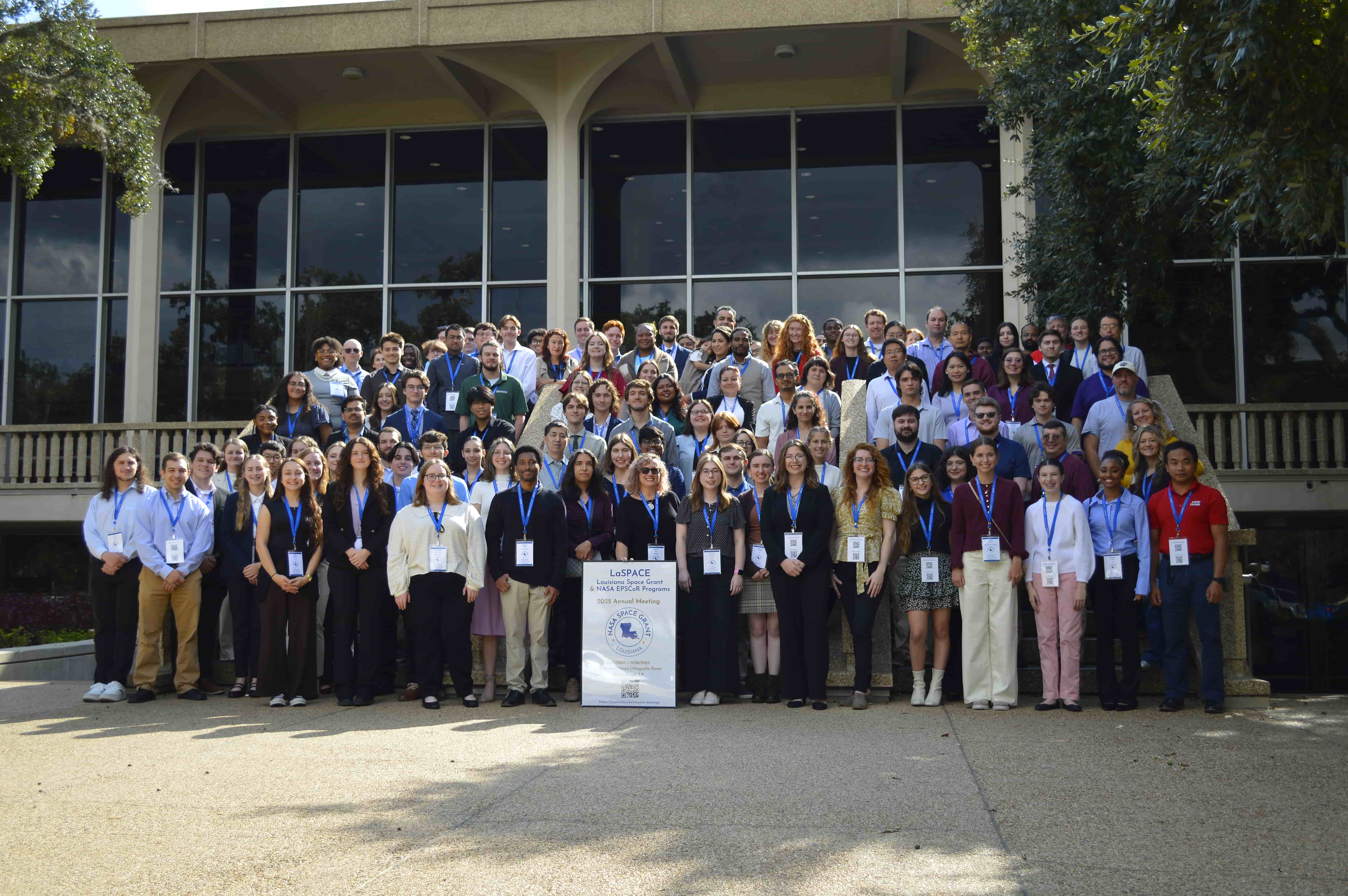
Louisiana Space Grant Consortium (LaSPACE), administered by Louisiana State University through the Department of Physics & Astronomy, is a statewide consortium established in 1991 under the National Space Grant College and Fellowship Program, a national network managed by NASA that includes all 50 states, the District of Columbia, and the Commonwealth of Puerto Rico. The LaSPACE mission is to engage college students, academic institutions, science organizations, government agencies, and industry in Louisiana to create a broad academic STEM ecosystem and build a robust NASA-aligned STEM workforce.
LIGO
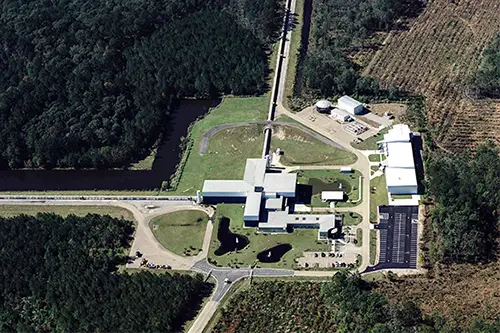
The Laser Interferometer Gravitational-Wave Observatory (LIGO) is designed to open the field of gravitational-wave astrophysics through the direct detection of gravitational waves predicted by Einstein’s General Theory of Relativity. LIGO’s multi-kilometer-scale gravitational wave detectors use laser interferometry to measure the minute ripples in space-time caused by passing gravitational waves from cataclysmic cosmic sources such as the mergers of pairs of neutron stars or black holes, or by supernovae. LIGO consists of two widely separated interferometers within the United States—one in Hanford, Washington and the other in Livingston, Louisiana—operated in unison to detect gravitational waves.
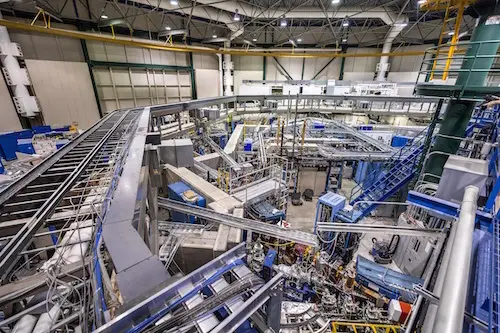
Louisiana Light Source
Louisiana Light Source, formerly CAMD, is a synchrotron radiation research center at Louisiana State University in Baton Rouge. The mission of Louisiana Light Source is to provide infrastructure for research and education in synchrotron-based science and technology. The facility was built with a $25-million grant from the U.S. Department of Energy and is currently operating with an annual state-provided budget of $4 million. Research in the basic sciences and microfabrication is conducted by scientists and engineers from Louisiana universities, as well as distinguished scientists from national and international institutions.
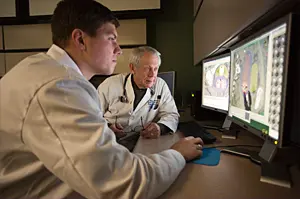
Medical Physics
LSU’s Medical Physics facilities provide access to advanced facilities for radiation detection, medical imaging, radiochemistry, dosimetry, and radiation transport research. Students also gain experience with clinical equipment at Mary Bird Perkins Cancer Center and Our Lady of the Lake Regional Medical Center, as well as biological research facilities at Pennington Biomedical Research Center. Specialized software and nuclear data libraries further support dose calculations, reactor physics, and shielding analysis.
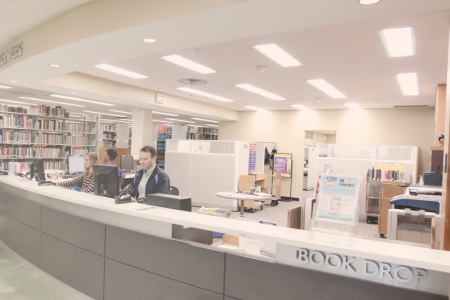
University Libraries
LSU Libraries rank among the nation’s leading research libraries, with extensive collections in Middleton Library and unique Louisiana and Lower Mississippi Valley materials in Hill Memorial Library. Students also have access to a specialized physics and astronomy library within the department and the medical physics library in the program office and at the Cancer Center.
Additional Resources
- Particle Astrophysics/Space Science: emulsion developing, scanning, and digitized measuring machines, detector development laboratory.
- Nuclear: isotope separator and spectroscopy laboratory (at the Oak Ridge National Laboratory).
- High Energy: drift-chamber and calorimeter construction facilities.
- Condensed Matter: Crystal growth including floating zone optical furnaces, thin film fabrication including laser MBE facilities, STM/AFM, and optical and transport measurement facilities.
- Low Temperature-General Relativity: high vacuum electron-beam melting apparatus, superconducting microcircuitry construction facilities.
- Astronomy/Astrophysics: 20-inch Ritchey-Chrétien telescope and CCD camera.